
Interview - Mateen Amrohvi
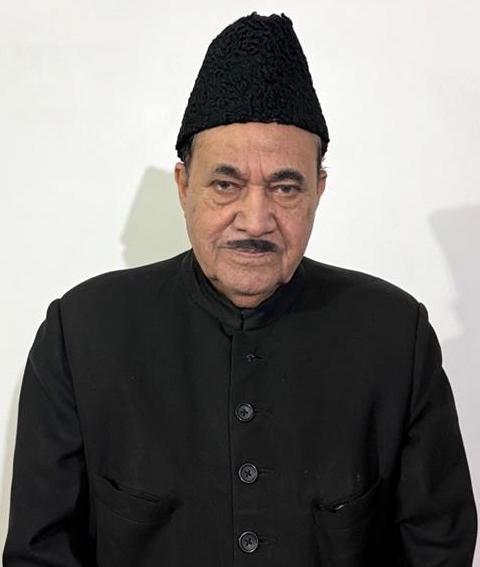
 Mateen Amrohvi is an Urdu poet who has represented Amroha at the Lal Qila Mushaira for almost half a century since 1975. He wrote a collection of ghazals in the metre of Ghalib. Primarily self-taught, Mateen is a prominent figure in India’s mushaira scene. His energy, positivity, and, above all, his love for Amroha are evident in every conversation.
Originally from Gher Pachaiyya (though he says he belongs to the entire city), he now resides in Delhi near the burial place of Sufi saints with whom he shares a deep connection.
1 Was it only poetry or any other art that attracted you?
I have had a passion for poetry since childhood, because in the families of scholars, academic, literary, and religious inclinations are intertwined. After coming to Delhi, this passion grew to the point of obsession, and I started writing poetry — or poetry began to happen by itself — because I never tried to be called a poet or to become one, nor did I have that desire.
In my house, poetry was read and heard, but singing, let alone music, was a different matter; no one could even hum in front of the elders. Because of this, my musical talent was also stifled in my throat.
2 What role did Delhi play in your journey?
It is my great fortune that in Delhi I found such an environment, such intellectuals and elders, whose benevolent gaze changed my destiny. Among these benefactors, I am first and foremost indebted to Khwaja Hasan Sani Nizami, the Sajjada Nasheen of the shrine of Nizamuddin Auliya, under whose patronage I achieved a status for which I do not consider myself worthy.
The boundaries of the house where I live meet the resting place of Hazrat Amir Khusrau, my poetry is its reward.
From the shrine of Mehboob-e-Ilahi, prominent poets have received blessings. Akbar Allahabadi, Josh Malihabadi, Saghar Nizami, Allama Anwar Sabri, Pandit Anand Mohan Zartishi, Gulzar Dehlvi, are all nightingales of this Nizami garden. Ghalib still serves as a doorkeeper of that very door today. Whatever I have received has come from this very door.
3 Did you have any formal training in poetry?
None. But I was fortunate to have good advisors and intellectuals. Among them, I will specifically name Ali Muhammad Khusrau, Professor Nisar Ahmed Farooqi, and Professor Anwar Siddiqui.
Regarding poetry, it is a God-given talent. If I find that my couplet resembles some other poet’s work, I immediately remove it. For that reason, I don’t try to get my work corrected by anyone; whatever I have is my own, and it is before the readers as it is.
“Hum sukhan faham hain Ghalib ke tarafdar nahin”
We are connoisseurs of poetry, not fans of Ghalib.
4 Talking of Ghalib. What inspired you to write “Gulha-e-Sukhan Bar Zameen-e-Ghalib” (A Bouquet of Verses on Ghalib’s Meter)?
I wrote this book for a single reason: people used to say that no one can write in Ghalib’s metre, that it is impossible to compose poetry in his style. They claimed that nowhere in the world had such a feat been attempted as I attempted. I wrote only out of deep devotion to Ghalib.
My home is just opposite Ghalib’s resting place. I am always near his mausoleum when I come and go. People admired many of the couplets I wrote in his style, and I would tell them, “I do not deserve this praise—my only motive was reverence for Ghalib.”
Ghalib has a famous couplet:
Bekhudi be-sabab nahin Ghalib
Kuchh to hai jis kī pardadari hai
This ecstasy is not without a cause, Ghalib
There is something there that remains veiled
In response, in my own ghazal, I placed a girah (a creative knot) on the same theme:
Hai azal se hareem e naaz me wo
Kuchh to hai jis kī pardadari hai.
Since eternity in the sanctuary of grace
There is something there that remains veiled
Let me share some more examples from my ghazals.
Poochiye dil se ishq me aise qadam uthaye kyun
Khud hai be-nahe dard-e-dil karta hai hai hai kyun
Ask the heart why it takes such steps in love—
It is helpless; the pain of love makes it sigh and cry.
Ye kahne ko sabhi kahte hain Kaabe se sanam nikle
Hamare dil se wo nikle na unke dil se hum nikle
Sitare jin ko samjha thha meri chashm-e-baseerat ne
Jub un ko ghaur se dekha tere naqsh-e-qadam nikle
It is said that idols leave the Kaaba,
But neither did he leave my heart, nor did I leave his.
Those stars my inner sight had once revered
When I looked at them closely, they revealed your footprints.
Tamanna aarzoo armaan hasrat ke alawa bhi
Hazaron khwaishen aisi ki har khwaish pe dum nikle
Beyond desire, longing, passion, and yearning,
Lie thousands of wishes—each enough to steal one’s breath.
Because of this book, I travelled to places like Iran and Saudi Arabia, in addition to my tours in India.
5 You wrote quatrains for the daily Urdu newspaper Huma and Nai Duniya. How different was that experience?
Yes. For the past fifty years, one of my quatrains has been published daily in newspapers discussing current affairs. I used to write for Nai Duniya (New World), then for their sister paper Awam (Public), and later for Sahafat (Press) from Amroha. For several years now, my daily quatrains appear in Inquilab (Revolution).
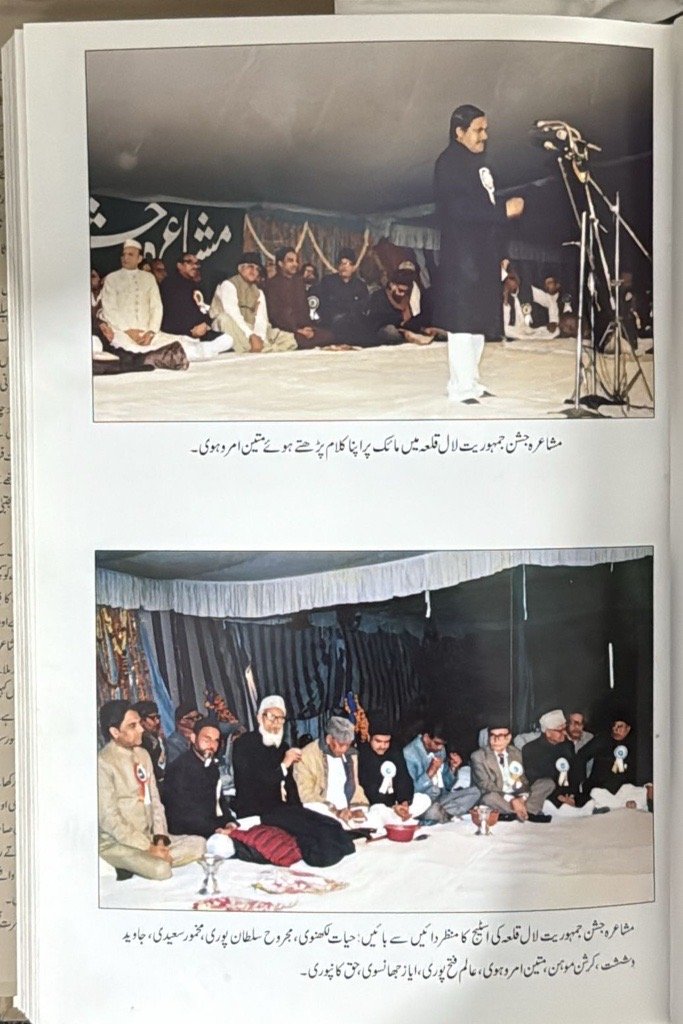
6 Having attended the Lal Qila Mushaira for decades as a poet, you must have seen many things. Is there a particular incident you’d like to share?
When the Delhi Urdu Academy was being established, Indira Gandhi was the Prime Minister. At that time, we approached her and said that Delhi should have an Urdu Academy.
This mushaira has been held since the 1950s, dating back to the time of Pandit Nehru. However, there was no Urdu Academy at that time. The mushaira was traditionally organised under the banner of the Kala Parishad, a cultural society. Later, the idea arose that such an important mushaira should be conducted under the auspices of the Urdu Academy, and I was involved from the very beginning.
For forty-eight years, I recited at the Red Fort Mushaira. One reason was that I was among those who helped establish the Academy. When we requested Indira Gandhi to form an Urdu Academy, she said, “Go and request the Lieutenant Governor Jagmohan.” We then told her about meeting him earlier and his reply, “Get an approval from Madam; once I have her indication, I will build it.”
The Academy’s budget was allocated in 1979, and by 1981, it was fully operational. After that, the Red Fort Mushaira began to be held under the auspices of the Academy.
Thousands upon thousands would gather for the mushaira, but it is no longer held at the Red Fort and is now held elsewhere.
Due to popular demand, Shariful Hasan Naqvi requested me to begin the mushaira. I started with these lines:
Kar rahi hai raqs gulshan me shameem
Jashn ye jamhuriyat ka hai azeem
Kar Mateen aaghaaz bismillah se
Rasm ye bazm-e-sukhan ki hai qadeem
The garden’s breeze is swaying in delight
The festival of democracy is grand tonight
Mateen, commence with ‘Bismillah,’ as is the creed
This assembly of verse is old in custom and in deed.
I would often start with these couplets about Amroha:
Tehzeeb-o-tamaddun ke main saache men ḍhala hun
Amrohe ki pur-kaif faẓaon men pala hun
Dillī ne nawaza hai mujhe sher-o-sukhan se
Main Mushafī ke naqsh-e-kaf-e-pa pe chala hun
Formed in the crucible of culture and grace
Raised in Amroha’s enchanted
fragrant space. Delhi adorned me with the gift of song
I follow Mushafi’s steps, steadfast and strong
The mushaira is now held outdoors and no longer has the same grandeur.
7 Raees Mirza from Amroha was also a regular host of such cultural events in Delhi. Do you have any personal recollection of him or other poets from Amroha?
I enjoyed a pleasant time with him and Zaheen Naqvi, who was then secretary of the Ghalib Academy in Delhi. He hosted many mushairas and events. Raees had a good sense of humour. There was a gentleman in Delhi who boasted that after he gave a rupee to his elder son-in-law, he became a millionaire through a garment business. Raees teased the gentleman, “If you had given a penny to your younger son-in-law, he too might have turned out to be someone worthwhile.”
I wrote many anchoring lines for him, such as this:
Ankhon se kahe koi aankhon se sune koi
Is tarze takallum ko kahte hain ghazal goi
Eyes speak in silence, and eyes reply in kind
This wordless art of converse is what we call the ghazal
Once Jaun Elia visited my home in Delhi with Zaheen late in the evening. I asked Zaheen about his late arrival. He replied, “Ye kah rahe thhe ek sahib ne apna diwaan undel diya mere upar, mujhe tu Mateen ke pass le chal. Main usse kuch sununga to meri tabiyat halki ho jayegi” (“He (Jaun) is saying that a person dumped his poetry on him! Take me to Mateen’s house. I’ll listen to his poetry to lighten up.”). Jaun asked me to put a charpoy under the Neem tree in my courtyard. I recited the following ghazal to him:
Abhi go maine pehchani nahin hai
Magar awaaz anjaani nahin hai
Safine ko mere kya raas aaye wo
Darya jisme tughyaani nahin hai
I have not yet recognised the face,
Yet the voice is far from unfamiliar.
What joy can those waters bring my vessel,
A river where no tumult ever stirs?
The following couplet made him cry, and he remarked that it is a 1300-year-old sher (alluding to the tragedy of Karbala).
Bahut dushwaar hai raahe muhabbat
Kahin is raah me paani nahin hai
The path of love is painfully hard
No water to be found along this way
I continued…
Mateen usko kaho yakta ke uska
Zamane me koi saani nahin hai
Mera diwana jo kahti hai duniya
Ye duniya koi diwani nahin hai
Call him unique, O Mateen, for truly
There is none in the world who can match him
The world may call my passion madness,
Yet this world itself is no mad thing.
A matlua mushaira was once organised by Kunwar Mahendra Singh Bedi, in honour of Raees Amrohvi with the matla (opening couplet),
Khamosh zindagi jo basar kar rahe hain hum
Gahre samundaron me safar kar rahe hain hum
The silent life we are living through
We journey on in oceans dark and deep.
I composed a ghazal based on it and am sharing a quatrain from my composition.
Jo lamha zindagi ka basar kar rahe hain hum
Ek maarka hayaat ka sar kar rahe hain hum
Koi hamari raah me patthar na phenk de
Sheeshe ki palki me safar kar rahe hain hum
Each fleeting moment of the life we live
Is a battle of existence we must win
Let no one cast a stone upon our path
We travel in a palanquin of glass
8 What memories do you have of Amroha?
I have so many memories associated with Amroha. My early education took place there, and Master Abdul Rauf was one of my teachers. I later moved to Delhi, completed a diploma in automobile engineering, and then earned my degree. After that, I secured a government job with the CPWD (Central Public Works Department).
Back in Amroha, literary gatherings took place regularly—mushairas were held, and I took part. For forty years, I recited at various mushairas, including manqabati mushairas, naatia mushairas, and baharia mushairas. I also participated in Hussain Day at Majapota.
Even today, people there remember me fondly. However, many of my contemporaries—those of my age and within my circle—have now passed away. A new generation has risen in their place.
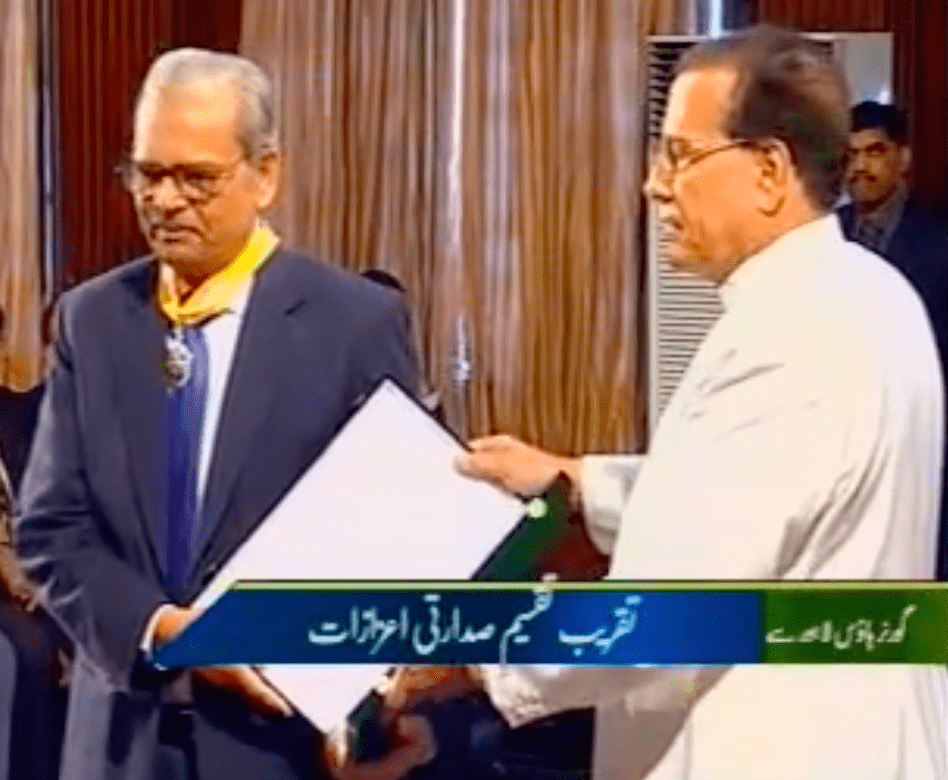
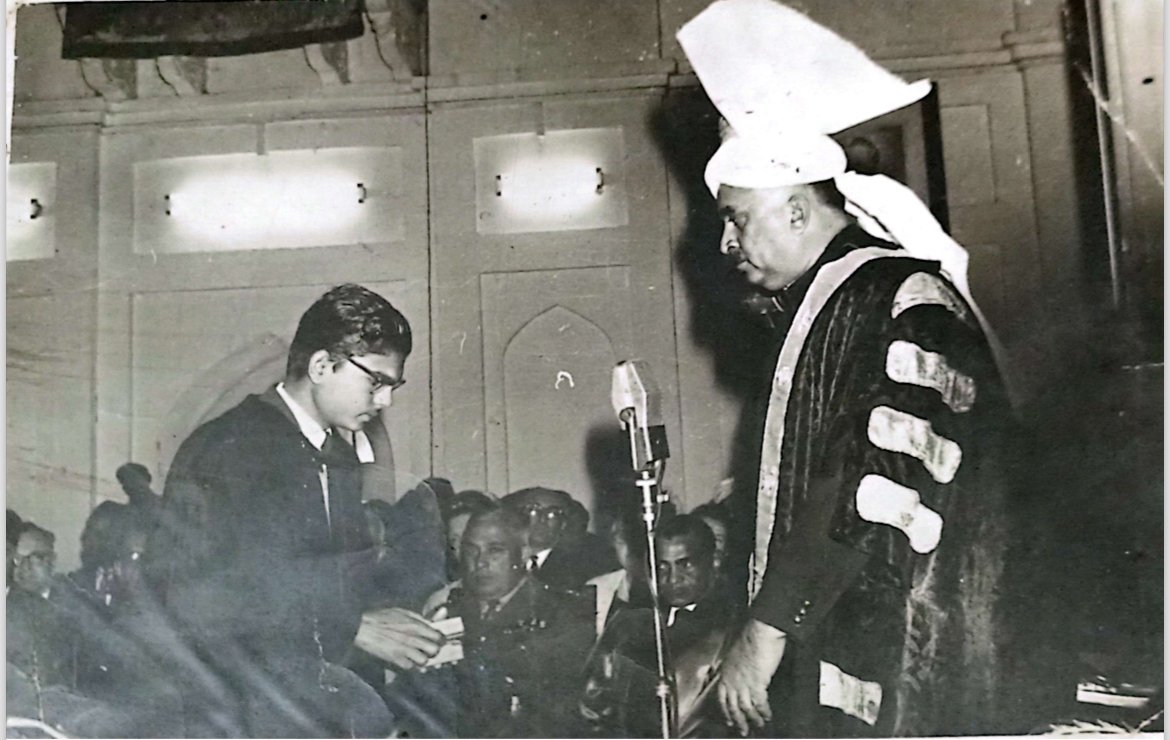
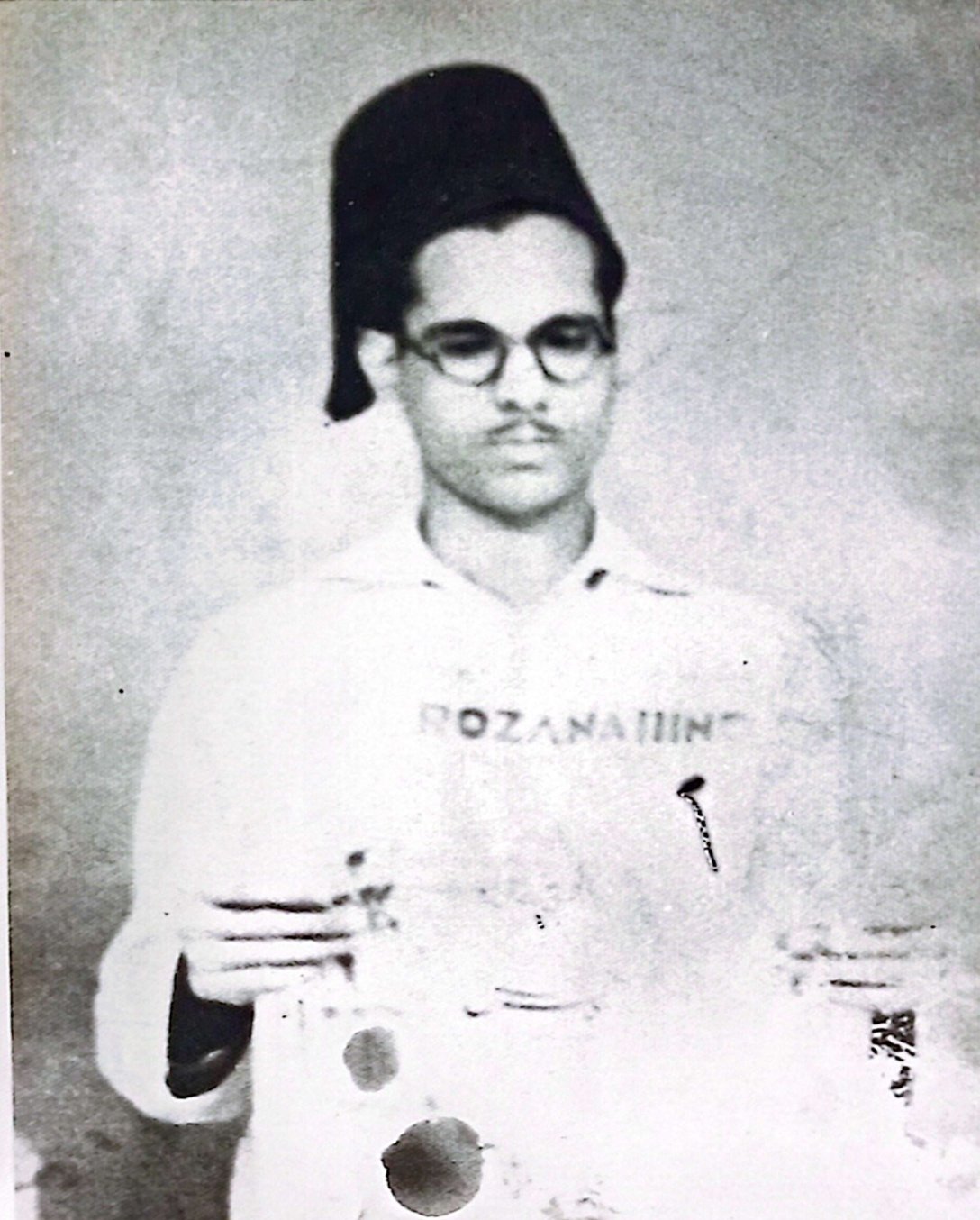
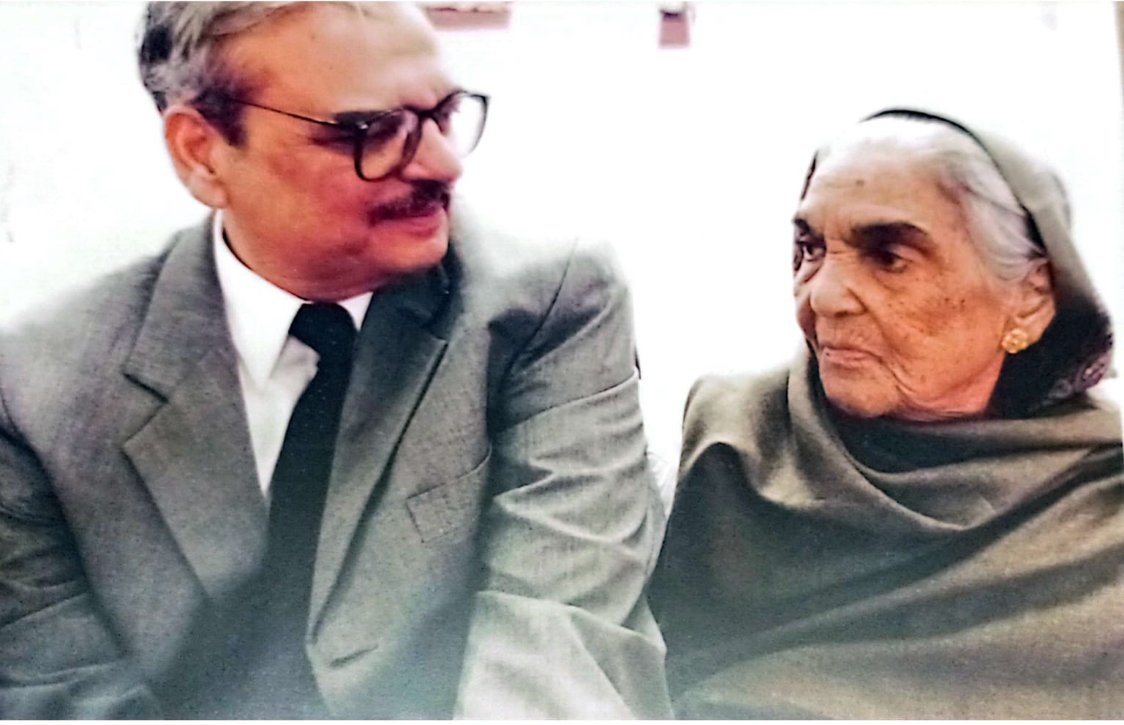
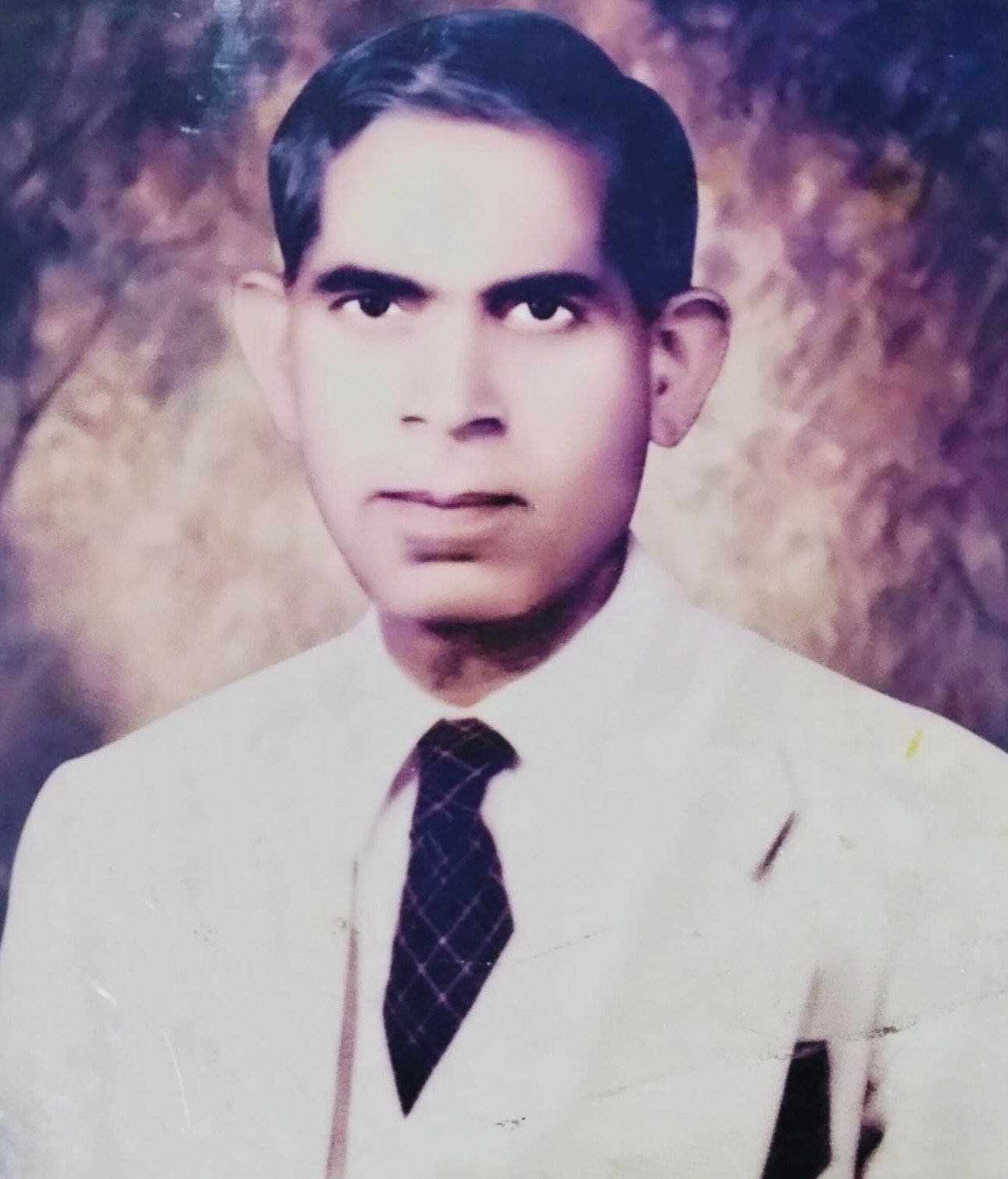
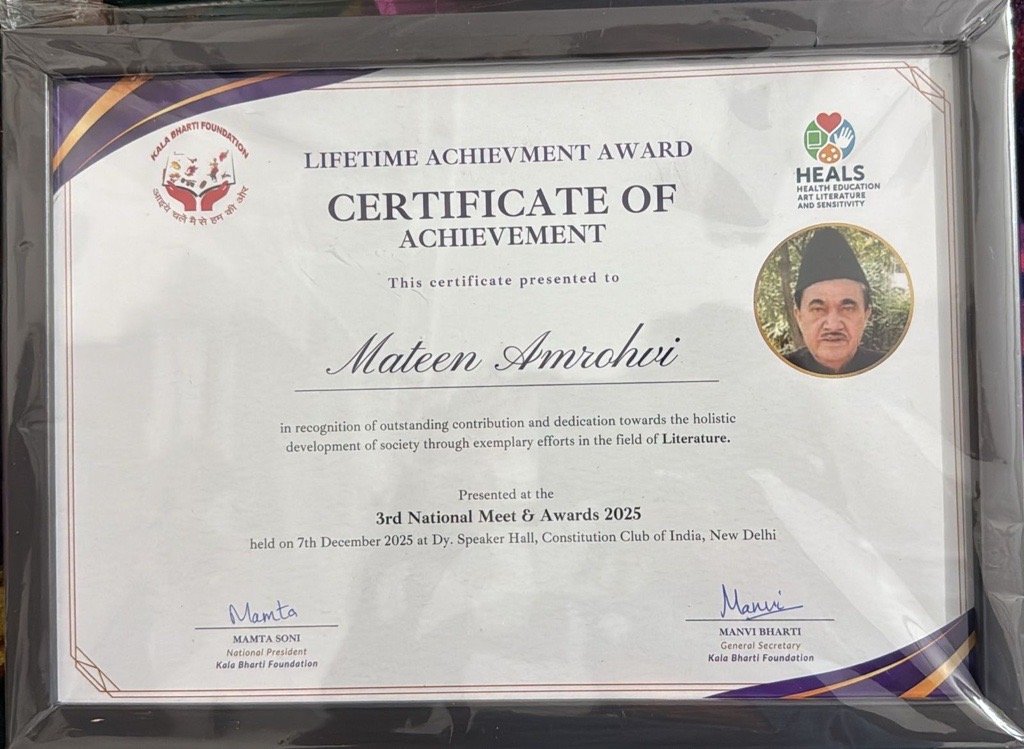
Mateen Amrohvi in conversation with Inam Abidi Amrohvi. (December 8th, 2025)