
Pushte Rasool-e-pak par jalwa-numa Imam dou
Markab-e-khush khiraam aik, raakib-e-lala-faam dou
Zaate Muhammad-o-Ali asl hai aik, naam dou
Maikadah-e-vajood mein badaa hai aik, jam dou 1
Upon the Prophet’s sacred shoulders, sit radiant Imams two
One graceful steed carrying, rosy riders two
Essence of Muhammad and Ali, the same, though names two
In the tavern of existence, wine is one, served in cups two
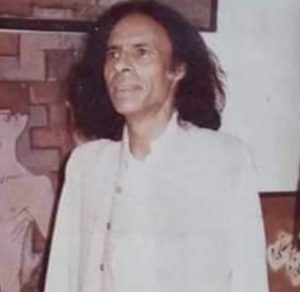 The manqabat (devotional poem) celebrates the unity of divine light in the Prophet Muhammad, his grandsons Hasan and Husain, and his son-in-law Ali. To many, the poet behind these lines, Jaun Elia, may seem an unlikely source, yet his work often defied expectations. His manqabats have been popular in Amroha.
As mentioned in my book ‘Making of a Qasba: The Story of Amroha’, Jaun was in pursuit of the unknown, and in that futile quest, he consumed himself. His first poetry collection, Shayad, was published when he was 57. Even this was made possible by the Herculean efforts of his friends, for he was his own worst critic and believed his work would be published only if God willed it.
After he passed away, another volume Yaani prepared under his guidance was published. Thereafter, several other collections were published. Would Jaun himself have approved of all these posthumous works beyond Yaani? Only Jaun knows.
In the words of poet Azeem Amrohvi, Jaun was, at his core, a ghazal writer. Though he wrote nazms and prose, his temperament suited the ghazal.
Words came to him in abundance, though at times his expressions seemed excessive. Ayatollah Syed Hamidul Hasan, a prominent Shia cleric whom Jaun respected greatly, once received a letter from the poet, written in blood. He recalls an encounter in which Jaun told him, “Bhai, main ek minute me teen sher kahta hoon.” (Brother, I can compose three couplets in a minute.) The cleric shares couplets from his many interactions with the poet.
Ye be-khudi* aur be-khabari be-sabab** nahin
Aksar ye sochta hoon ke kya sochta hoon main
*self-forgetfulness **without a cause
&
Aa jao ke bahr-e-hasti* ko is tarah se hum taqseem karein
Saahil pe tumhara qabza ho tufaan hamara ho jaaye
*ocean of existence
Jaun’s poetry reflects a longing for a distant past and the sadness that accompanies the disappearance of a world he held dear.
Thi jo woh ek tamseel-e-maazi*, aakhri manzar uska yeh tha
Pehle ek saaya sa nikal ke ghar se baahar aata hai
Uske baad kayi saaye se use rukhsat karte hain
Phir deewaarein dhay jaati hain, darwaaza gir jaata hai
*allegory of the past
The couplets delve into symbolic storytelling, guiding the reader through the end of an era. The shadow signifies a fading identity; shadows represent memories; walls stand for identity, and the door represents a connection to the world.
Jaun’s distinctive notions of love and hate set him apart. On one occasion, a girl in love with the poet visited his home while he was eating. Seeing her, he refrained from chewing, which he considered inappropriate in the presence of a beloved.
Hai mohabbat hayat ki lazzat,
Varna kuch lazzat-e-hayat nahin
Kya ijazat hai ek baat kahun
Vo magar khair koi baat nahin
*pleasure of life
His prose also resonates deeply with his readers. A family member in Pakistan, Kazim Saeed, feels it captures the sweep of human intellectual history. Sample this excerpt from Farnood:
Insaaniyat ki sab se badi neki daanaaii hai, aur daanaaii ka sabse achcha wazeefa kalaam hai. Kalaam apne aalam-e-istiraahat me khayal hai aur aalam-e-bedaari me awaaz. Mai kayenaat ke be-karaan sukoot aur isteghraaq me apni awaaz ke siwa aur kya hoon. Hum wahan tak hain jahan tak hamari awaaz jaati hai.2
daanaaii: wisdom, wazeefa: expression, aalam-e-istiraahat: state of rest, aalam-e-bedaari: state of awakening, be-karaan: boundless, sukoot: silence, isteghraaq: absorption
Jaun argued that the word ‘hatred’ is inherently objectionable, suggesting that it has been created and perpetuated by societal elites, to which the masses subsequently conform.
Band rahe jin ka darwaza aise gharon ki mat poochho
Deewaren gir jaati hongi aangan rah jaate honge
Kazim contends that Jaun Elia’s most significant poetic contribution is his aafaqi shayari (universal poetry), which highlights the flaws of contemporary society.
Suno ke ferdowsiye zamana parakh chuka zarf-e-ghaznavi ko
Jo fikr-o-fan ko zaleel kar ke azeez rakhta hai ashrafi ko
Taqaduss-e-but-shikan* me dekha takalluf-e-zauqe-but-gari** ko
Ab ek hajv-e-jadeed*** likhni hai asre haazir ki shayari ko
*sacred pose of the idol-breaker **careful craft of idol-making
***fresh satire
Notice how the poet exposes today’s world, where wealth is worshipped, truth is staged, and even poetry has lost its soul.
Despite his poetic and intellectual stature, Jaun believed that society did not adequately value intellectuals. Although their ideas provided the basis for the modern scientific age and shaped human relationships, the respect or rewards they received were more like patronage than the recognition they deserved.
Aik shai ehtraam-e-ilm bhi hai
Is ka kuch kuch khayal to rakhiye
A society he continually questioned.
Jaun valued truthfulness in an environment often marred by deception. He maintained that although individuals may abandon one another, humanity endures. While personal experiences are situated in time, the concept of humanity itself transcends eras.
Aye qaatilon ke shahr bas itni si arz hai
Main huun na qatl koi tamasha kiye baghair
Part of this worldview emerged from the tragedy of Karbala. As his former wife, Zahida Hina, observed, the image of Imam Hussain’s head poised on a spear seemed to draw him towards it.
Ho jung jeetna to sipar* bhi hai qeemti
Tareekh jeetna ho to Asghar** bhii kuch nahin
Main pesh kya muqaddama***-e-karb-o-bala karuun
Iss baab^ mein to daawar-e-mehshar^^ bhi kuch nahin 3
*shield **Hussain’s infant son in Karbala (‘karb’ means tribulation and ‘bala’ means trial) ***case
^matter ^^judge of the judgement day
This resonance extended to many others: my schoolmate and activist Ashish Awasthi, who fondly calls Jaun ‘bade abba’ (a reverential uncle) and often quotes his couplets; Shiraz Husain, a multidisciplinary artist who created popular posters of the poet; and Muntazir Firozabadi (Anant Bhardwaj), an assistant professor enamoured of Jaun’s poetry who wrote a book on him.
Summing up the impact of Jaun’s art, poet and critic Dr Hilal Naqvi feels that Jaun Elia’s poetry is his life. Similarly, poet Ajmal Siddiqui finds it remarkable that Jaun managed to weave together philosophy, psychology, world literature, and human nature with honesty, all while honouring the traditions of Urdu poetry. Compiler of Jaun’s work, Khalid Ahmad Ansari, believes that Jaun’s words, whether written or spoken in private, were steeped in knowledge and philosophy. He also notes that Jaun possessed a profound understanding of Islamic history.
The reduction of such an intense poet to a mere caricature in certain quarters of electronic and social media is troubling.
To understand Jaun Elia, one must delve into his poetry and philosophy, which say you must break yourself to build yourself.
Apni tameer-e-jaan-o-dil* ke liye
Apni buniyaad hum ko dhaani hai
*constructing the self
Once you have done that, Jaun Elia’s eccentricities will reveal their true depth. You may find, in understanding him, a path to a deeper self-understanding.
1 Hilal-e-Gham, Azeem Amrohvi
2Essay “Aawaz” in Farnood: Jaun Elia ke Inshaiye aur Mazameen (1958-2002), edited by Khalid Ahmed Ansari
3 Manqabat published in Rashtriya Sahara, Siraj Naqvi
By Inam Abidi Amrohvi, author of ‘Making of a Qasba: The Story of Amroha’, with inputs from Kazim Saeed in Pakistan, Huma Rizvi and Mehran Amrohi in India.